Knowing what is GEO is only the first step. The next question is how you can actually use it.One of the most important principles of GEO is creating content that is clear, credible, useful and trustworthy.AI systems need to understand your information before they can potentially use it in their responses. This means your content should not simply contain the right keywords. It should provide meaningful answers to the questions your audience is asking.Create Question-and-Answer ContentA question-and-answer structure can make content easier to understand.For example, instead of writing a long paragraph around a topic, you can use a heading such as:What is GEO?Then provide a direct and easy-to-understand explanation underneath it.This structure connects the question with the answer and makes individual sections of your content useful even when they are viewed independently from the rest of the page.Focus on Content StructureContent structure is another important part of GEO.Use clear headings, subheadings, short paragraphs and straightforward explanations. Each section should provide enough context for the reader to understand the subject without having to search through the entire article.The goal is to create context-rich content that can be easily understood by both humans and AI systems.Type your paragraph here
A question-and-answer structure can make content easier to understand.For example, instead of writing a long paragraph around a topic, you can use a heading such as:What is GEO?Then provide a direct and easy-to-understand explanation underneath it.This structure connects the question with the answer and makes individual sections of your content useful even when they are viewed independently from the rest of the page.Focus on Content StructureContent structure is another important part of GEO.Use clear headings, subheadings, short paragraphs and straightforward explanations. Each section should provide enough context for the reader to understand the subject without having to search through the entire article.The goal is to create context-rich content that can be easily understood by both humans and AI systems.Type your paragraph here
Type your paragraph hereTo fully understand what is GEO, it is important to understand how it differs from traditional SEO.SEO primarily targets search engine results pages, while GEO targets AI-generated responses.With SEO, the objective is often to improve rankings and encourage users to click your link. Keywords, backlinks and technical SEO elements can help search engines discover, understand and rank your webpages.GEO has a different emphasis. It focuses more heavily on the actual information contained within your content and how easily AI systems can retrieve and understand it.Another major difference is the way success is measured.Traditional SEO is generally click-driven. You want your webpage to rank highly so users click on it and visit your website.GEO is more exposure-driven. Your content or brand may appear within an AI-generated response, increasing visibility even if the user doesn't immediately click a link.This doesn't mean clicks are no longer important. Instead, visibility now exists in more than one form
What Are the Recent Updates in GEO?
GEO is still a relatively new concept, and the way AI search works continues to develop.Google has introduced AI-generated summaries through its AI search experiences, while platforms such as ChatGPT and Perplexity have made conversational search increasingly popular.This means the search ecosystem is moving beyond the traditional model of:Search → Results → Click → WebsiteIt is increasingly becoming:Question → AI-generated answer → Sources and citationsThis change means content creators need to think about how their information can be understood and used by AI systems.Another important development is the growing discussion around standards and technologies designed to help AI systems interact with web content. GEO is still not as widely established as SEO, but it is becoming an important consideration for marketers who want their content to remain visible across different search platforms.However, businesses should not expect a single GEO technique to guarantee that their content will appear in every AI response. AI platforms use different systems and ranking processes, so the best approach is to focus on creating genuinely useful and authoritative content.Type your paragraph here
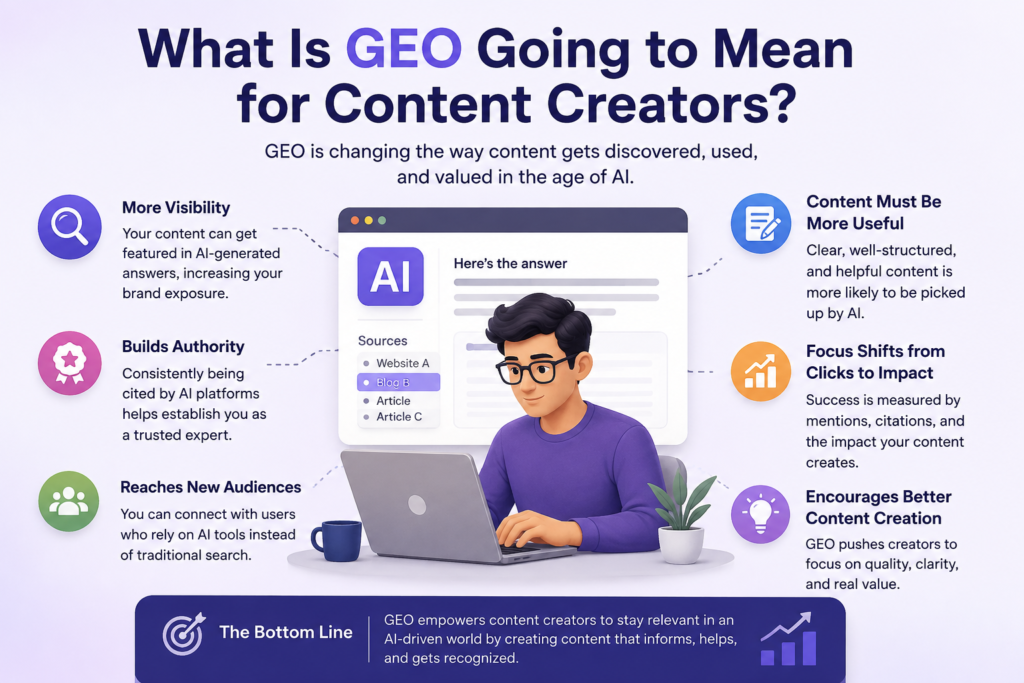
For content creators and marketers, what is GEO is becoming more than just a definition to learn. It represents a change in how content should be created.The old SEO mindset was largely about becoming number one on Google.The emerging GEO mindset is about becoming a source that AI can trust.That means content needs to answer real questions, provide useful information and demonstrate expertise. Instead of writing exclusively for search-engine rankings, creators need to consider how their content can provide complete answers that AI systems can understand and potentially reference.This doesn't mean every article needs to be completely rewritten. Many SEO principles still translate directly into GEO. The key is understanding the difference and adapting your strategy accordingly.
So, what is GEO? Generative Engine Optimization is an emerging approach to optimizing content for AI-powered search and generative engines.SEO and GEO have many similarities. Both aim to make high-quality, relevant content more visible online, and both benefit from understanding user intent.The major difference is where that visibility happens.SEO focuses on ranking your content in traditional search results and encouraging clicks. GEO focuses on making your content understandable, useful and trustworthy enough to potentially be referenced within AI-generated answers.As platforms such as ChatGPT, Perplexity and Google's AI search experiences continue to influence how people find information, GEO is becoming an important part of the modern content strategy.The goal isn't to replace SEO. The goal is to combine SEO and GEO so your content can remain visible wherever your audience is searching.The future of search may not simply be about being number one on a results page. It may increasingly be about becoming the source that AI trusts enough to include in its answer.